
About Simplus CE Capillaries
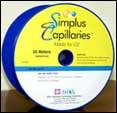
10 + 25m are supplied
on a convenient spool
Simplus CE Capillaries are high-quality bare fused silica capillaries designed for capillary electrophoresis (CE), capillary electrochromatography (CEC), microfluidic applications, and related analytical techniques.
Each capillary is manufactured from high-purity fused silica and protected with a durable polyimide coating that allows safe routine handling while maintaining flexibility and strength. Simplus capillaries are supplied on convenient spools and are available in lengths commonly used for analytical method development and routine laboratory applications.
Proper Handling of Bare Fused Silica Capillaries
Although fused silica capillaries are surprisingly flexible, they remain precision glass components and should be handled carefully.
General Handling Recommendations
- Avoid sharp bends.
- Protect capillaries from impact damage.
- Avoid scratching or nicking the external coating.
- Protect capillaries from aggressive chemical exposure.
- Inspect capillaries regularly for signs of stress or damage.
Damage such as scratching, chemical etching, or excessive bending can create stress points that may lead to capillary failure during operation.
Bare Fused Silica Bending Stress
Strength of the capillary tubing or the column tubing can be affected by chemical modification in the capillary or by being exposed to the elements. Care should be exercised in bending the capillaries and columns. The following table shows bending radius for typical MICROSOLV CE Capillaries and CEC Columns.
Understanding Bend Radius and Capillary Stress
The polyimide coating provides flexibility, but excessive bending can increase mechanical stress on the fused silica tubing.
As bend radius decreases:
- Mechanical stress increases.
- Risk of capillary breakage increases.
- Long-term reliability may decrease.
For best results, use the largest practical bend radius and avoid tight coils whenever possible.
Bend Radius (mm) OD 365um Tubing
| Applied Bending Stress (kpsi) | 4 | 6 | 8 | 10 | 15 | 20 | 25 | 30 | 40 | 50 | 60 | 80 | 100 | 130 |
| Bend Radius | 476 | 318 | 238 | 191 | 127 | 95 | 76 | 64 | 48 | 38 | 32 | 24 | 19 | 15 |
Pressure and Temperature Considerations
Care should be exercised whenever capillaries are operated under pressure.
Important considerations include:
- Internal pressure
- Elevated temperatures
- Chemical compatibility
- Mechanical stress
- Existing surface damage
The combination of pressure, heat, and microscopic defects can significantly reduce capillary lifetime.
Flow Behavior in Capillaries
Flow resistance in capillaries is highly dependent on internal diameter.
Important Principle
Small reductions in internal diameter dramatically increase flow resistance.
For example:
- A reduction from 100 µm ID to 50 µm ID produces approximately four times greater flow resistance.
When selecting capillary dimensions, both flow requirements and operating pressure should be considered.
Keeping in mind the Bernoulli Principle, it is important to remember that when a viscous liquid flows through a pipe, the speed of the liquid at the center of the pipe is greater than near the walls due to friction and other factors. This resistance to flow can be written as:
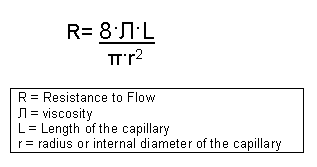
As the resistance to flow is inversely proportional to the square of the radius (ID), a change from 100mm to 50mm means a four-fold resistance to flow and a subsequent difference in flow rate.
Trace Elements in Bare Fused Silica
Simplus capillaries are manufactured from high-purity fused silica containing only trace levels of metallic and non-metallic elements.
These extremely low impurity concentrations help support:
- Reproducible CE performance
- Low background interference
- Reduced contamination risk
- Consistent electroosmotic flow characteristics
The trace element data shown below provide typical elemental composition specifications for the fused silica material.
| Element | Symbol | By Weight |
| Aluminim | Al | 0.1 (0.05) |
| Antimony | Sb | 0.002 |
| Arsenic | As | 0.03 |
| Boron | B | 0 to 0.01 |
| Cadmium | Cd | 0.0002 |
| Calcium | Ca | 0.1 (0.05) |
| Chromium | Cr | n.d. |
| Copper | Cu | 0.0004 |
| Gallium | Ga | n.d. |
| Gold | Au | n.d. |
| Iron | Fe | 0.2 (0.02) |
| Lithium | Li | 0 to 0.05 |
| Magnesium | Mg | 0 to 0.1 (0.0005) |
| Manganese | Mn | 0 to 0.01 |
| Phosphorous | P | 0.01 to 0.1 |
| Potassium | K | 0 to 0.001 (0.01) |
| Silver | Ag | n.d. |
| Sodium | Na | 0.04 (0.05) |
| Titanium | Ti | 0 to 0.1 (0.05) |
| Uranium | U | n.d. |
| Zirconium | Zr | 0 to o.001 |
Couplers and Connectors
Couplers and connectors are available for all common capillary sizes.
Recommendation
When joining two fused silica capillaries:
- Use fused silica connectors whenever possible.
Benefits include:
- Matching thermal expansion characteristics
- Reduced leak potential
- Reduced contamination risk
- Improved long-term connection stability
Metal connectors may introduce contamination, unwanted interactions, or leak issues in some applications.
Fluorescence Characteristics
Some fused silica materials exhibit fluorescence when exposed to ultraviolet light.
Simplus bare fused silica capillaries are manufactured to provide very low fluorescence characteristics and are free from visible fluorescence above 290 nm, making them well suited for many fluorescence-based analytical applications.
Removing Polyimide Coating
In some applications, it may be necessary to remove polyimide coating to create detection windows or prepare capillary connections.
Recommended Methods
Electric Coil Heater
- Convenient for small detection windows
- Fast and practical
- Commonly used for CE applications
Electric Arc
- Effective for bare fused silica
- Maintains excellent glass strength
CO₂ Laser
- Produces highly precise windows
- Minimal damage to fused silica
- Often considered the preferred technical method
Heated Sulfuric Acid
- Effective for complete coating removal
- Suitable for bare fused silica and some coated capillaries
- Requires strict laboratory safety procedures
Methods Generally Not Recommended
Open Flame
Can weaken fused silica and create brittle areas.
Gas Torch
May damage the capillary and presents laboratory safety concerns.
Strong Bases
Can attack both the coating and the silica itself.
Wire Strippers
Frequently damage the glass surface and create stress points.
Applications
Simplus CE Capillaries are commonly used for:
- Capillary Electrophoresis (CE)
- Capillary Electrochromatography (CEC)
- Method Development
- Biomolecule Analysis
- Pharmaceutical Analysis
- Environmental Testing
- Microfluidics Research
- Academic Research